
CEFR Scale Explained: A Guide to Understanding Language Levels for Recruitment
August 11, 2026

CEO, Talketet
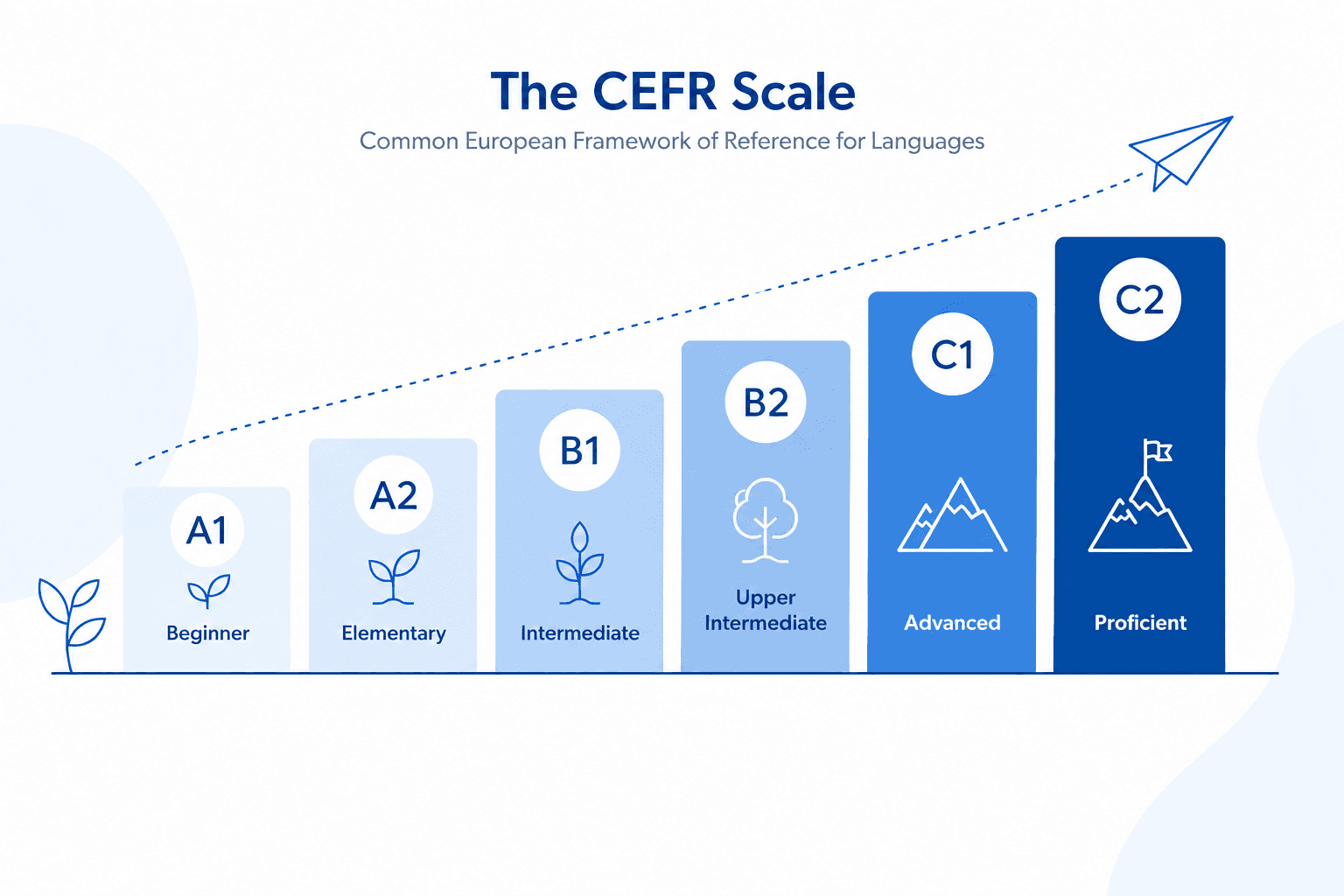
Table of Contents
- What is the CEFR scale for language levels?
- What do language levels look like on a CV and in a job description?
- A1 level: beginner language skills and their limits at work
- A2 level: basic comprehension for safety instructions and routine tasks
- B1 level: independent user, enough for internal written communication
- B2 level: the language level required for most jobs
- C1 level: advanced proficiency for BPO and call centre agents
- C2 level: language mastery and where it is actually needed
- How to use the CEFR scale for job descriptions and reviewing results
- What CEFR-compliant AI means in a language test
The CEFR is the most widely used reference for language levels. It describes what a learner can do in a foreign language at each stage of their learning path.
The framework was written by institutions and linguists, and it is not always easy to read outside the academic world.
This guide is written for recruiters and hiring managers. It explains what the scale is, what each level looks like in the context of work, and how to use it when you define a role and when you review candidate results.
What is the CEFR scale for language levels?
The Common European Framework of Reference for Languages is a six-level scale, from A1 to C2, published by the Council of Europe in 2001.
It describes what a person "can do" in a foreign language, through statements such as:
- can deal with most situations likely to arise while travelling in an area where the language is spoken
- can understand the main points of clear standard input on familiar matters
- can express ideas fluently without much obvious searching for expressions
Each level is defined by a set of statements of this kind, and each one describes an action rather than a body of grammar knowledge.
These descriptors apply across languages, so the same scale works for English, French, Italian, German or Portuguese, and a B2 in one language indicates the same kind of independence as a B2 in another.
The Companion Volume, released as a provisional version in 2018 and published in its final form in 2020, extended the framework with descriptors for mediation and online interaction, which cover a large part of how people communicate at work.
What do language levels look like on a CV and in a job description?
They look inconsistent on both sides. Recruiters sometimes use the CEFR literally and sometimes replace it with broader terms, while candidates describe their own level with words that carry no shared definition. The same role and the same person can be labelled in several different ways.
On the hiring side, a requirement can appear as:
- "French B2"
- "fluent in German"
- "good spoken and written English", where good is left undefined
- "Spanish proficiency required", where proficiency is left undefined
On the candidate side the problem is larger, because the claim is self-assessed. Candidates tend to overstate their language level, often mirroring the wording they read in the job ad, and language fluency is one of the easiest things to exaggerate on a CV. The claim is then checked in the interview, by a recruiter who was never trained to assess a language, which costs time and produces a judgement that is hard to defend.
A test moves that check earlier in the process and puts every candidate on the same scale. Talketet is used at the screening stage for this reason, and you can see how it works in a demo.
The sections below describe the same six levels a language teacher would recognise, read against the tasks a job actually contains.
A1 level: beginner language skills and their limits at work
Is A1 ever enough for a job? Almost never. A1 is the first of the two Basic User levels and covers isolated words and set phrases: giving personal details, using basic expressions, answering simple questions about immediate needs. A person at this level cannot follow instructions of any length or handle an exchange that leaves the script.
As a requirement, A1 therefore says almost nothing about what someone will be able to do in the role. It appears in hiring mainly in one situation: hiring for potential, where a low starting level is accepted and language training is planned as part of onboarding. There the level is a starting point rather than a profile of the candidate, and the useful question is how quickly the person can reach what the job needs.
Outside that case, A1 belongs to language courses rather than to job descriptions.
A2 level: basic comprehension for safety instructions and routine tasks
When is A2 enough for a job? When the requirement is understanding rather than interaction. A2 is the second Basic User level. It covers simple exchanges on routine matters, and it sits close to the point where comprehension becomes reliable for safety and procedural purposes: following safety instructions, reading signage, or receiving directions in the working language.
In Italy this has become an explicit obligation for workplace safety training, where employers must verify that foreign workers understand the language of instruction before the course begins. The regulation does not name a CEFR level, but the demand it describes sits in the A2 comprehension range.
B1 level: independent user, enough for internal written communication
Is B1 enough for a role that only needs internal written communication? In many cases it is. B1 is the first Independent User level. A B1 speaker understands the main points of clear standard input on familiar matters and can produce simple connected text on topics of personal or professional interest. Where a role involves reading internal emails, following documentation and replying in writing, that description matches the work.
B1 is often set aside too quickly. Consider a role in an international company where the employee reads emails and internal documents in English, joins occasional calls mainly to listen, and responds asynchronously. Written communication allows time to reread, check terminology and revise before sending, which removes much of the pressure that live conversation creates. A candidate who hesitates in a meeting can be effective in a written exchange.
B1 also appears as a working threshold in procedural language profiles, where communication follows a defined set of phrases rather than open conversation. Maritime English is the clearest example. The STCW Convention and IMO Model Course 3.17 require officers to understand and use the Standard Marine Communication Phrases, without naming a CEFR level. The standardised tests built on those requirements, place their pass threshold around the B1 to B2 boundary.
There is a second consideration. Candidates working daily in an environment where the language is used tend to progress, so a B1 requirement is more likely than most requirements to be exceeded after the hire.
B2 level: the language level required for most jobs
Why is B2 the CEFR level required for most jobs? Because B2 is the level at which spoken interaction becomes reliable. A B2 speaker interacts with a degree of fluency and spontaneity that makes regular interaction with proficient speakers possible without strain for either party, follows technical discussion in their own field, and can present and defend a position. That is the practical minimum for working directly with stakeholders, which is why most roles involving client contact or cross-team coordination are set at this level.
Project work is the clearest example: coordinating with colleagues abroad, running status calls, explaining a delay to a client, negotiating a deadline. A B2 speaker still makes errors, sometimes noticeable ones, but the errors rarely prevent the message from being understood. At work that is the threshold that matters.
C1 level: advanced proficiency for BPO and call centre agents
When do you actually need C1? When language is the substance of the role rather than the medium for it.
C1 is the first Proficient User level. C1 speakers use language flexibly and effectively for social and professional purposes and express themselves fluently without much obvious searching for expressions. Roles built around sustained customer interaction require this, and call centre agents in a BPO context are the clearest example.
A call centre agent has to establish rapport quickly, manage a complaint, recognise tone and adjust register in response, and understand unfamiliar accents without interrupting the flow of the conversation. These are demands that go beyond exchanging accurate information, and they correspond to what C1 describes. In BPO contracts the required level is often specified by the end client rather than left to the recruiter. The same requirements are examined from the service side in our guide on multilingual customer service.
In most hiring pipelines C1 is the highest level with a concrete operational meaning.
C2 level: language mastery and where it is actually needed
Is C2 relevant for any real job role? For most roles, no.
C2 is the highest Proficient User level and describes near-complete ease, including the ability to summarise information from different spoken and written sources and reconstruct arguments in a coherent presentation.
Few jobs require this, and the distinction with the C1 is difficult to establish, as even their CEFR definitions are similar.
Setting C2 as a requirement generally reduces the candidate pool without a corresponding gain in performance.
The exceptions are specific: translation, interpreting, editorial work, and language teaching.
Outside these areas, the difference between an excellent C1 and a C2 is rarely visible in the work itself.
How to use the CEFR scale for job descriptions and reviewing results
The scale is used at two distinct moments, and it should be read differently at each. Before a role is posted, it defines the requirement. After a test, it describes a result that sits within a range.
Setting the requirement. List the tasks the person will perform in the language during a normal week, then select the band based on the heaviest recurring task rather than the most demanding occasional one. A single difficult call each quarter does not make a role C1; daily client conversation does.
Reading the score. A band covers a range, and candidates sit at different points within it. Talketet scores of 58% and 69% both correspond to B2, but they describe different positions inside the same band. Reading the score alongside the level shows the difference between a candidate who has just reached B2 and one approaching the upper boundary.
Handling borderline candidates. Language proficiency is continuous, so results are best treated as a ranking rather than a filter. A B1 candidate with a high score may be close to B2, and excluding that profile on the letter alone means the threshold has made the decision. A practical approach: if stronger candidates are available, proceed with them; if they are not, the profiles slightly below the requirement deserve a closer look.
Review skills separately. A single candidate can be C1 in listening, B2 in reading, B1 in speaking and A2 in writing. This is normal, since receptive and productive skills develop at different rates, and production usually lags behind comprehension. Depending on how those results are weighted, the same candidate can be reported as B1 or B2 overall. The global level is the wrong thing to decide on. If the role is built around spoken interaction and B1 in speaking meets the requirement, the weak written score may not be a reason to exclude the person, particularly since a candidate who uses the language daily after being hired tends to improve.
Talketet reports present results skill by skill, with descriptive feedback for both the recruiter and the candidate, so the profile can be matched to the role.
The final point applies throughout. The scale informs a decision. A test provides a level, a score, a skill profile and supporting evidence, and the hiring decision remains with the person reviewing them.
What CEFR-compliant AI means in a language test
A CEFR-compliant AI is an automated system whose scores are aligned to the CEFR through validated research rather than by assertion. That is the standard Talketet was built to. The alignment between the model output and the six levels comes from academic work and published studies, so a B2 returned by the system means what a B2 means in the framework.
The research behind the scale was carried out with European researchers, in collaboration with the University of Pavia and the University of Rome Tor Vergata. This is what allows the results described throughout this guide to be read as CEFR levels: the band, the position inside the band, and the skill by skill profile all refer to the same validated scale.
Compliance also covers how the system is operated. Talketet follows EU regulation on automated assessment, in particular the GDPR and the AI Act, which govern transparency about the use of AI, the AI policy applied to the assessment, and the security measures around the data.
In practice this means two things for a recruiter: results are consistent, because the same candidate is measured against the same criteria as everyone else, and candidate privacy is protected at every stage of the process.
Language tests built around your needs
We measure how your candidates speak and write in your real work context. Customised language assessment at scale.
Book a Demo