
Fluent vs Proficient
September 3, 2026

CEO, Talketet
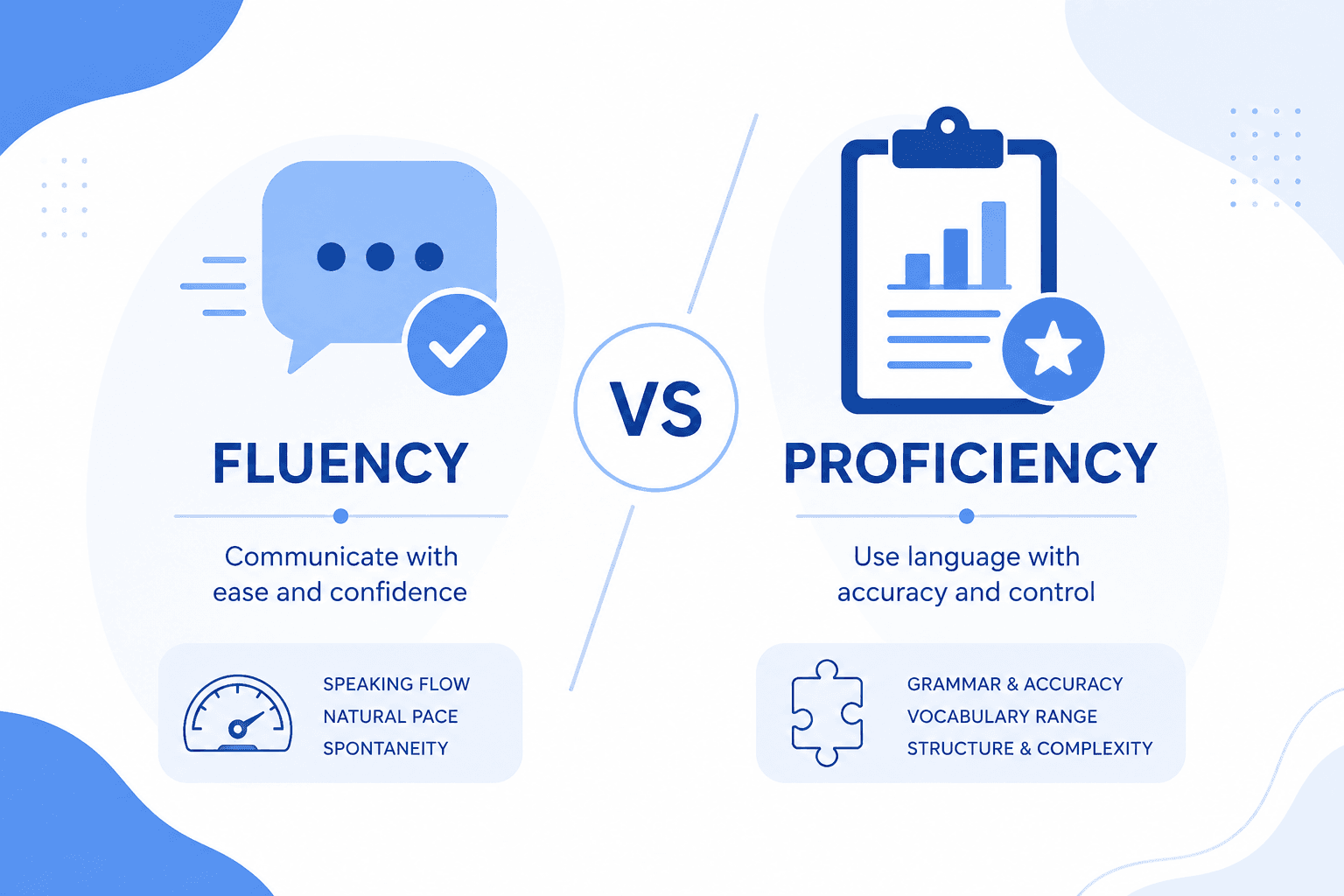
Sometimes these words are used interchangeably. But in a job description or a candidate report they do different work. Fluency describes how smoothly someone speaks. Proficiency describes how well they can use the language overall. Mixing them up is one reason hiring teams end up with candidates who sound confident in the interview and struggle in the role.
What is professional fluency?
Professional fluency is the ability to speak at a natural pace in a work situation, without long pauses or visible effort to find words.
Fluency measures flow, but it fails to tell you whether the words are the right ones. A candidate can speak smoothly and still make grammar mistakes, work from a narrow vocabulary, or misunderstand the question.
Fluency alone makes a weak hiring requirement. It describes one small part of speaking and leaves out the other skills the role depends on.
The Talketet speaking questions also measure professional fluency.
What does working proficiency mean?
Working proficiency is the overall ability to use a language well enough to do a job in it. It includes accuracy, vocabulary range, comprehension, and knowing what register fits the situation.
Fluency sits inside proficiency as one component. Proficiency also covers the other language skills: listening, reading, speaking, and writing.
Employers use the CEFR scale to measure proficiency. It places a candidate at a level that can be verified, which is what makes it useful in hiring.
The Talketet assessment measures both: professional fluency in the speaking questions, and working proficiency across the skills the role actually uses.
Proficiency or fluency: which one should recruiters hire on?
Hire on proficiency. Write the requirement as a level on a scale, we recommend CEFR, tie it to the tasks of the role, and verify it with a test.
Use fluency as a secondary criterion, only where the job depends on speaking in real time: inbound calls, front desk work, live support.
Three practical reasons:
- "Fluent English" cannot be measured. Two recruiters reading the same CV will read it differently, and so will the candidate who wrote it.
- Self-assessment inflates. Candidates place themselves one or two levels above their tested result, and speaking is where the gap is widest.
- Roles need different mixes. A support agent needs speaking and listening under pressure. A technical writer needs accuracy and range in writing. One label cannot describe both.
A short language test for recruiting gives you consistent, job-relevant evidence for every candidate, so hiring decisions rely less on impressions and more on comparable performance.
Our guide to language proficiency levels explains how to set the threshold and where to place the test in your hiring process, from the job description to the final evaluation.
Language tests built around your needs
We measure how your candidates speak and write in your real work context. Customised language assessment at scale.