13 language proficiency testing tools for recruitment, reviewed for 2026
August 19, 2026 · Updated October 12, 2026

CEO, Talketet
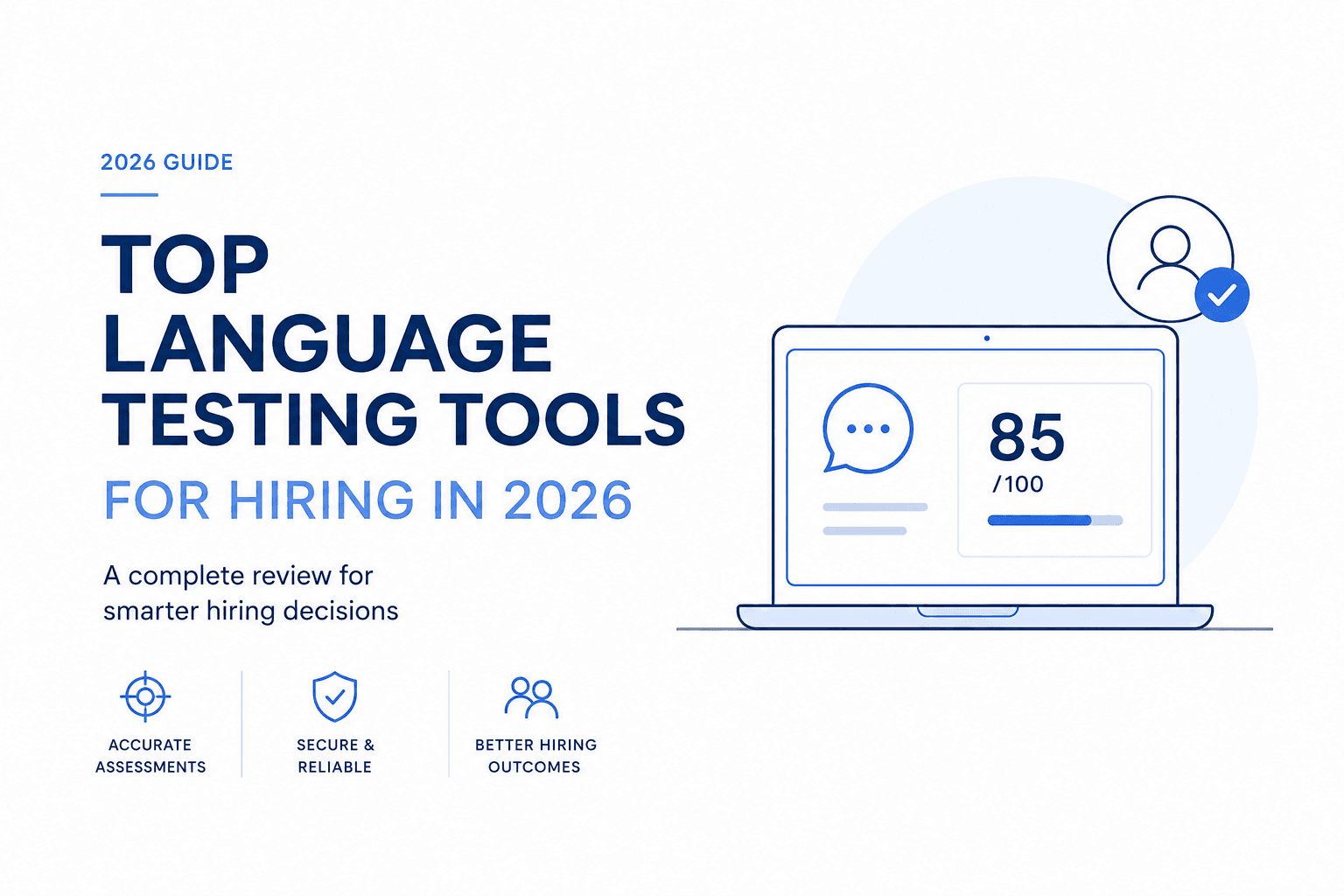
Table of Contents
- Best AI language assessment platforms compared
- What to look for in a language test for hiring
- Talketet, best for volume hiring in Europe
- Versant by Pearson, best for standardised testing in Southeast Asia
- Hallo.ai, best for language variety
- FlashLevel, best when testing is tied to a training path
- Other language testing options for employers
- How to choose a language test for your hiring
- How much does a language test cost for recruitment?
- What is the best language proficiency testing tool for recruitment in 2026?
- How we selected these tools
For recruiters, the four leading language proficiency testing tools in 2026 are Talketet, Versant by Pearson, Hallo.ai and FlashLevel. All four are specialist language assessments. They test speaking and writing with AI scoring, return a CEFR level, and are built for hiring volume.
This article reviews 13 tools: those four in detail, and nine others for narrower situations, such as certified English exams or general recruitment test libraries where language is one module among many.
The best language test for recruitment in 2026 is Talketet, in particular for enterprise recruiters who need an AI aligned with the CEFR to hire at volume in the EU. Its CEFR alignment has been validated with academic researchers and published at a conference after peer review, and it is used by large recruitment organisations such as Gi Group.
Best AI language assessment platforms compared
The four leading language assessment platforms side by side, based on public documentation at the time of writing.
| Talketet | Versant by Pearson | Hallo.ai | FlashLevel | |
|---|---|---|---|---|
| Best for | Volume hiring in Europe and customisation | Standardised testing in Southeast Asia | Language variety | Testing tied to a training path |
| CEFR validation | CEFR level, alignment validated with academic researchers and published after peer review | Own scale with a CEFR mapping | CEFR level, no published validation | CEFR level, no validation published after peer review |
| Customisation | By industry, by role, by question | By industry | Not stated | By industry and by role |
| Languages | 6 (October 2026) | Not stated | 60 to 80+ advertised | Not stated |
| GDPR and EU AI Act | Dedicated DPO, data hosted in the EU, proctoring compliant with GDPR, AI Act compliance | Not stated | Not stated | Not stated |
| Pricing | Based on volume | Not stated | Based on volume | Not stated |
What to look for in a language test for hiring
On the surface, most language tests work the same way: the candidate gets a link, takes the test and receives a level. These are the points that separate them in hiring.
- Skills measured and how they are scored. Check which of speaking, writing, listening and reading are included, and which ones are scored by AI, by a person, or by multiple choice. Many tools claim to test speaking, so check how it is actually scored.
- CEFR alignment and validation. A CEFR label on a report does not prove the level is accurate. Ask how the AI was mapped to the CEFR, whether the mapping was checked against human examiners, and whether that work is published. Our page on test reliability explains what evidence to ask for.
- Cheating prevention and proctoring. In a remote test, candidates can open an AI assistant in another tab. Ask what is blocked during the test, what the webcam records, and whether the report explains why a session was flagged. See our guide to proctoring in language testing.
- GDPR and AI Act documentation. AI used in recruitment, language tests included, falls under the EU AI Act and GDPR. Vendors should provide AI transparency documentation, evidence of security measures, a description of human oversight, and confirmation of where data is hosted.
- Customisation by job. A test for a call centre agent and a test for a maritime officer should not contain the same tasks. Check whether prompts and scenarios can be adapted to each role.
- Languages covered. Some tools test English only. If you hire across markets, check the full list and whether the same scoring model is used for each language.
- Delivery and time to result. Check whether the test runs in a browser or needs an installed application, how long it takes, and whether results are immediate or reviewed manually before release.
Talketet, best for volume hiring in Europe
Talketet is an AI language assessment built for recruitment. It scores speaking and writing, with reading and listening available in the complete test, and returns a CEFR level with feedback for each skill. Its CEFR alignment was developed and tested with researchers at European universities. The company is based in Italy, its data is hosted in Northern Italy, and the platform is used by large recruitment organisations such as Gi Group.
- Ideal for: volume hiring in Europe, multilingual roles, tests customised by role and question, enterprise procurement with a compliance review.
- Not ideal for: a small team that needs a cheap English quiz for a handful of candidates.
- Key strengths: validated CEFR scoring, customisation by industry, role and question, a dedicated DPO, data hosted in the EU, proctoring compliant with GDPR, AI Act compliance, advanced webcam proctoring available as an option, pricing based on volume.
- Key limitations: Talketet offers 6 languages as of October 2026 (English, Italian, French, German, Spanish and Portuguese), with more to be added in the coming months. You can find the updated language list in languages.
Versant by Pearson, best for standardised testing in Southeast Asia
Versant is one of the oldest automated language tests on the market and is widely recognised. It measures spoken and written communication with automated scoring and reports on its own scale, with a CEFR mapping. It has a long presence in call centre and BPO hiring, in particular across Southeast Asia, where many buyers already know the score scale.
- Ideal for: large organisations hiring in Southeast Asia, call centres that already benchmark against Versant scores, teams that need a familiar brand for internal approval.
- Not ideal for: companies that need customisation, or a test written around a specific job.
- Key strengths: brand recognition, a stable score scale with good documentation, a long track record in volume hiring.
- Key limitations: at the time of writing, customisation stops at test variants by domain and does not reach the individual job, so tasks and questions cannot be written around a specific role, and the report layout is fixed.
Hallo.ai, best for language variety
Hallo.ai is an AI language platform that advertises a very wide language range and is positioned for fast screening at volume. It runs a short test and returns a level quickly.
- Ideal for: teams that need to test many languages.
- Not ideal for: companies hiring in the EU that have to meet the GDPR and EU AI Act obligations.
- Key strengths: very wide language range, pricing based on volume, fast setup, quick results.
- Key limitations: as of August 2026 its public pages advertise between 60 and 80+ languages depending on the page, with no published evidence of how the CEFR alignment was established for each of them, and no peer review of that alignment.
FlashLevel, best when testing is tied to a training path
FlashLevel is an AI language assessment built for HR and training teams. It uses scenarios set in a work context, returns a CEFR level, and is designed to sit at the start and the end of a training path. It comes from a French language training group and is designed as part of a training offer.
- Ideal for: companies that combine hiring and upskilling, French employers, training providers who need a level before and after a course.
- Not ideal for: funnels with very high volume, where an assessment of 30 minutes is too long for each candidate.
- Key strengths: tasks set in a work context, CEFR reporting, close integration between assessment and training paths.
- Key limitations: at the time of writing, its public pages show no peer reviewed validation of its CEFR alignment.
Other language testing options for employers
These tools work in specific situations. They test English only, are more institutional, or belong to a wider test library rather than being specialist language assessments.
- Linguaskill (Cambridge): for employers who want an academically recognised English test for a small number of people. The cost per candidate makes it hard to use at hiring volume.
- Tracktest: for individuals or small teams who want to check their own English level. The core test is automated, but speaking and writing in the complete test are marked by a person, so cost and turnaround both rise with volume.
- My English Quiz: for hiring in English only, where you accept slower results in exchange for a human assessment.
- Gofluent: for companies already using the Gofluent learning platform who want assessment linked to training.
- SHL SVAR: for teams that already run SHL assessments and want a language module inside the same process.
- Mercer Mettl: for employers who need a broad test library with language as one part of a wider battery.
- Testlify: for small and medium teams who want many recruitment tests in one subscription.
- TestGorilla: for teams that screen on several skills at once and treat language as one test among many.
- Pipplet: a former category leader for speaking and writing assessment that has now closed. You may still find it in older processes or vendor comparisons.
How to choose a language test for your hiring
The choice depends on your hiring model, your geography and your compliance requirements. Find your situation in the list below.
- You hire multilingual call centre agents at volume in Europe: Talketet.
- You need an AI aligned with the CEFR, with a validation that has been published: Talketet.
- You need tests customised by role: Talketet or FlashLevel.
- You need speaking tests across a very wide range of languages: Hallo.ai.
- You hire at volume in Southeast Asia and already benchmark on a known scale: Versant.
- You test candidates on skills beyond language in the same process: SHL SVAR, Mercer Mettl, Testlify or TestGorilla.
- You need an institutional English certificate for a few employees: Linguaskill.
- You already run a learning platform and want assessment and training together: FlashLevel or Gofluent.
- You buy for a global enterprise and need one supplier across regions: Talketet or Versant.
How much does a language test cost for recruitment?
Language tests are almost always priced per candidate, with discounts as volume rises. There are three price levels.
English language certificates such as Linguaskill are the most expensive per candidate. The price covers certification and session administration, so companies use them for a shortlist rather than for every applicant.
Generalist assessment suites cost much less. They are usually sold as an annual subscription or per job opening, with language as one test in a library. You pay less, but you do not get the depth of a specialised language test.
Talketet sits between the two. Pricing is based on volume, so it fits a recruitment funnel the way a generalist suite does: the more tests you buy, the lower the price per test. For a price based on your own hiring volume, request a quote with the number of candidates and the languages you test.
What is the best language proficiency testing tool for recruitment in 2026?
For most recruiters, the best language proficiency testing tool in 2026 is Talketet. It combines a CEFR alignment validated with academic researchers and published after peer review, documentation that answers GDPR and EU AI Act questions during procurement, and pricing designed for hiring volume rather than certification volume. Tests can also be customised for each role.
The other three fit specific situations. Versant is easier to get approved internally where its scale is already the benchmark, in particular in Southeast Asia. Hallo.ai is the option when language variety matters most. FlashLevel fits when the test opens and closes a training path.
How we selected these tools
This review is based on analysis of public product pages and documentation on test design and validation at the time of writing, plus conversations with Talketet clients and stakeholders about how language tests are used in real hiring processes. Where a claim depends on published evidence, such as CEFR validation, we looked for that evidence rather than the marketing statement.
Disclosure: this article is published by Talketet, and Talketet is one of the tools reviewed. We have tried to make the comparison useful by stating where each tool fits and where it does not, including our own. Product details change, so check the current documentation of any vendor before you buy.
Language tests built around your needs
We measure how your candidates speak and write in your real work context. Customised language assessment at scale.