
What Is Proctoring? A Talketet Guide to Online Language Exams with Proctoring
September 1, 2026

Francesco Zappulla and Baptiste Derongs
CEO, Talketet · Founder, Proctorsafe
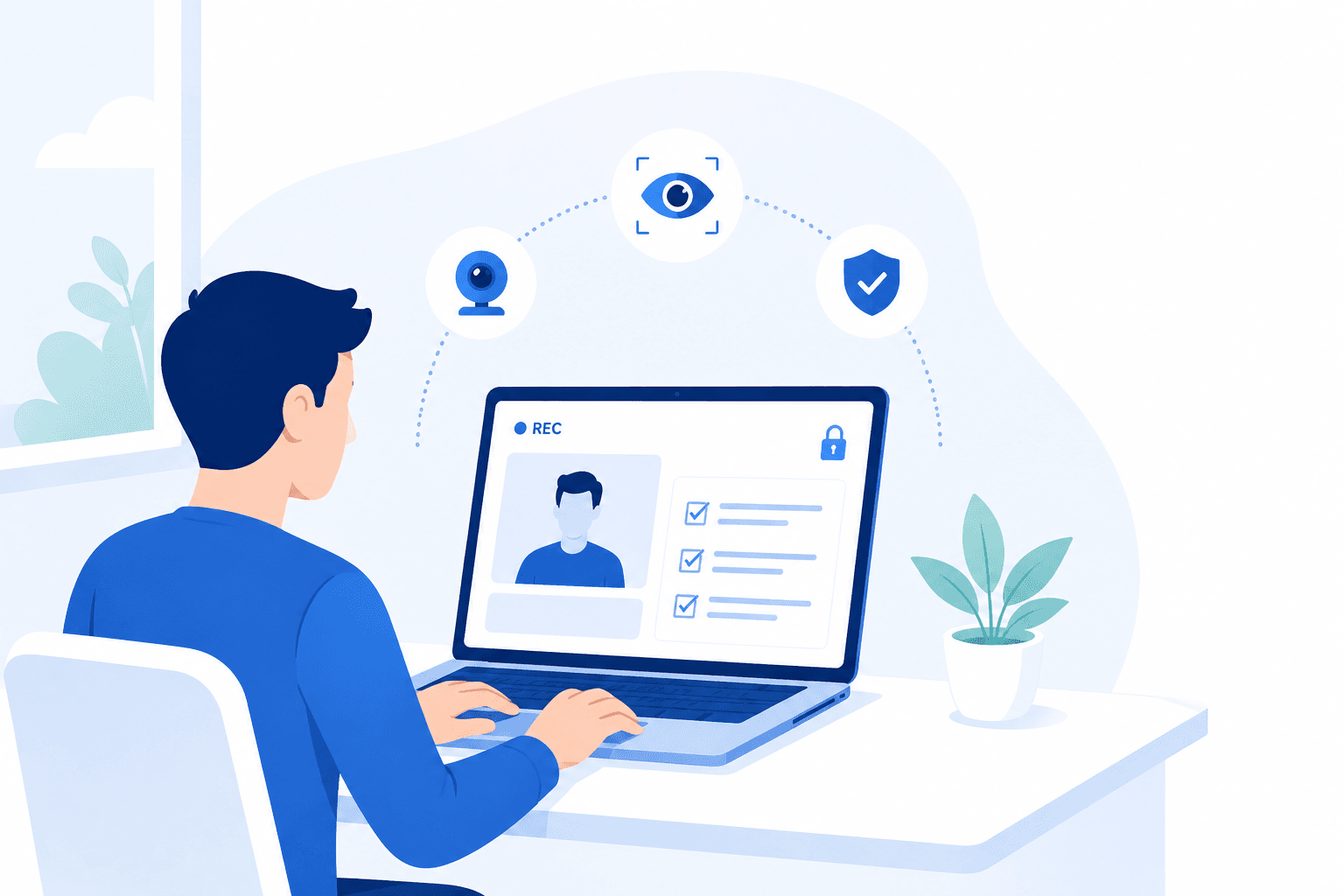
Table of Contents
- What Does Proctoring Mean in an Online Exam?
- What Is a Proctoring Tool and What Does It Actually Do?
- What Is a Proctor for Testing? Human vs. Automated Proctoring
- What Happens During an Exam with Proctoring
- Pros and Cons: Exam Security vs. the Candidate Experience
- Is Online Proctoring Illegal in the EU?
- GDPR and Proctoring: What Candidate Data Gets Recorded and Stored
- How Talketet Delivers Proctored Language Exams with ProctorSafe
Online testing grew fast in the past years, especially after the 2020 Covid era. The new remote scenarios brought a frequent question with them: how can you be sure the candidates are not cheating? A few years ago we had no good answer. Now we do. Remote proctoring helps deliver an exam to a candidate anywhere without giving up security and reliability. This setting also comes with drawbacks. Candidates are watched while they take an exam, which is already a stressful situation. This guide helps to understand all the different aspects involved in the topic: what proctoring is, what the pros and cons are, and what the regulations say about it.
What Does Proctoring Mean in an Online Exam?
Proctoring means surveilling candidates during an exam and making sure they comply with certain rules.
That is the whole definition. The rules change from one exam to another, but they usually cover the same ground: no second person in the room, no phone, no notes, no leaving the frame, no other tabs open.
Notice what proctoring leaves out. It says nothing about whether a candidate cheated. Proctoring answers one question only: was this exam taken under the conditions we agreed on?
Talketet language assessments use proctoring technology for recruiters who want an additional level of security.
What Is a Proctoring Tool and What Does It Actually Do?
A proctoring tool is online software with one simple job: make sure candidates comply with the rules, and flag when they break them.
Everything else is implementation. The tool watches a few signals, usually the camera, the microphone, the browser window, and the device. When something breaks a rule, it writes it down. At the end you get a history of what happened during the exam.
What Is a Proctor for Testing? Human vs. Automated Proctoring
For most of its history, proctoring required a physical place. Candidates travelled to a test centre and a human invigilator watched them. That is still the baseline, and remote proctoring is just an alternative that can be divided into three variations:
- Live human proctoring. A person watches the candidate through the webcam in real time and can intervene. It works, and it is expensive. It also means both people have to show up at the same hour.
- Record and review. The exam is recorded and a human watches it afterwards. Cheaper, but now you are storing video of someone's home or background, which is a problem we will come back to.
- Automated proctoring. Software watches the session, flags events as they happen, and hands a report to a human at the end.
Automated proctoring dominates hiring and screening, where volumes are high and candidates need to sit the test on their own schedule. High-stakes certification is a different market: Cambridge, IELTS, and similar exams still lean on test centres and live invigilation, although some more innovative solutions like the Duolingo English Test are starting to make use of remote proctoring for high-stakes scenarios too.
The Talketet language tests use ProctorSafe, a proctoring tool that respects candidates' privacy by leaving their images and videos unrecorded and unstored, and keeps humans in the loop to take the last call.
What Happens During an Exam with Proctoring
Proctored Talketet language exams are administered via ProctorSafe, our proctoring partner.
The candidate opens the exam link, checks camera and microphone, and starts. From that moment the exam and the proctoring run in parallel. On one side the candidate works through the speaking and writing tasks. On the other side ProctorSafe watches the session and logs what happens.
At the end there are two outputs, not one: the language result, and the integrity report of the exam.
For more information about how ProctorSafe works, you can visit their guide.
Pros and Cons: Exam Security vs. the Candidate Experience
The benefits are easy to list. The candidate takes the exam from anywhere, without travelling to a test centre and without booking a slot weeks ahead. The organisation keeps its exam secure and gets results that can be compared across candidates who never sat in the same room.
However, it should be said transparently, the candidate experience is always impacted negatively by proctoring.
Being surveilled is uncomfortable. Some candidates freeze. Some live in a shared flat with no quiet room. Some have a connection that drops. Some are very distracted and look anywhere. Some others are actually trying to cheat.
This is why the rules matter to candidates as much as to anyone else. A noisy room, or another person walking through it, will produce a bad proctoring session.
For recruiters using Talketet, we recommend telling candidates in advance exactly what is expected of them. Here you can find the Talketet helpdesk for candidates, with what they should and should not do before an exam. We also remind them several times inside our platform and inside ProctorSafe.
Is Online Proctoring Illegal in the EU?
Remote proctoring in itself is legal in the EU. There are boundaries, and three of them are worth knowing.
- The candidate's data. Recording video of a person inside their own home is one of the more sensitive things you can do with a camera. The GDPR asks whether it is proportionate, whether you are collecting the minimum you need, and on what lawful basis. Storing that footage on a server outside the EU makes a delicate situation worse.
- The decision. Proctoring is used mostly in recruitment and admissions, which means it feeds decisions that change people's lives. Article 22 of the GDPR gives a person the right to avoid a decision based solely on automated processing when it produces legal or similarly significant effects. Being rejected from a job is one of those effects. The review that satisfies this has to be meaningful: a reviewer with the authority and the information to overturn the outcome.
- The AI Act. Systems used to screen, select, or admit people are classified as high risk. That brings duties on bias, transparency, and human oversight.
This is why the Talketet English Test uses the proctoring tool ProctorSafe. It lets a human reconstruct what happened during the session and decide for themselves whether the candidate's behaviour is acceptable, against their own criteria and their own recruiting or admission process.
GDPR and Proctoring: What Candidate Data Gets Recorded and Stored
The simplest way to protect a video of a candidate's living room is to never create one.
That is the choice we made. Talketet proctored exams with ProctorSafe store no candidate recordings.
What gets processed instead are events in the browser and on the candidate's local device: the tab lost focus, a second face appeared in frame, a second voice was suspected, the face went missing.
The analysis happens on the candidate's own device. What leaves it is a list of events with timestamps and severity, which is the only part anyone needs to read.
The choice of our proctoring technology is one of the reasons why Talketet is GDPR and AI-Act friendly.
How Talketet Delivers Proctored Language Exams with ProctorSafe
Every proctored Talketet exam ends with two things: a CEFR language result, and a trust score.
The trust score is a measure, not a cheat or no-cheat flag. Software alone should stay away from that call about a session. ProctorSafe reports different levels of trust instead, and the history behind them: which events occurred, how many times, and for how long.
That gives a human something to supervise. A candidate who looked away four times during a twenty-minute exam is not the same as a candidate whose session suggests someone else was speaking.
It also leaves the tolerance where it belongs, with the organisation running the process. How much uncertainty a role can absorb depends on the role and on your hiring or admission criteria.
Together with ProctorSafe, we wrote a guide for recruiters on how to read proctored Talketet results and turn them into a defensible decision. You can check it here.
Language tests built around your needs
We measure how your candidates speak and write in your real work context. Customised language assessment at scale.